
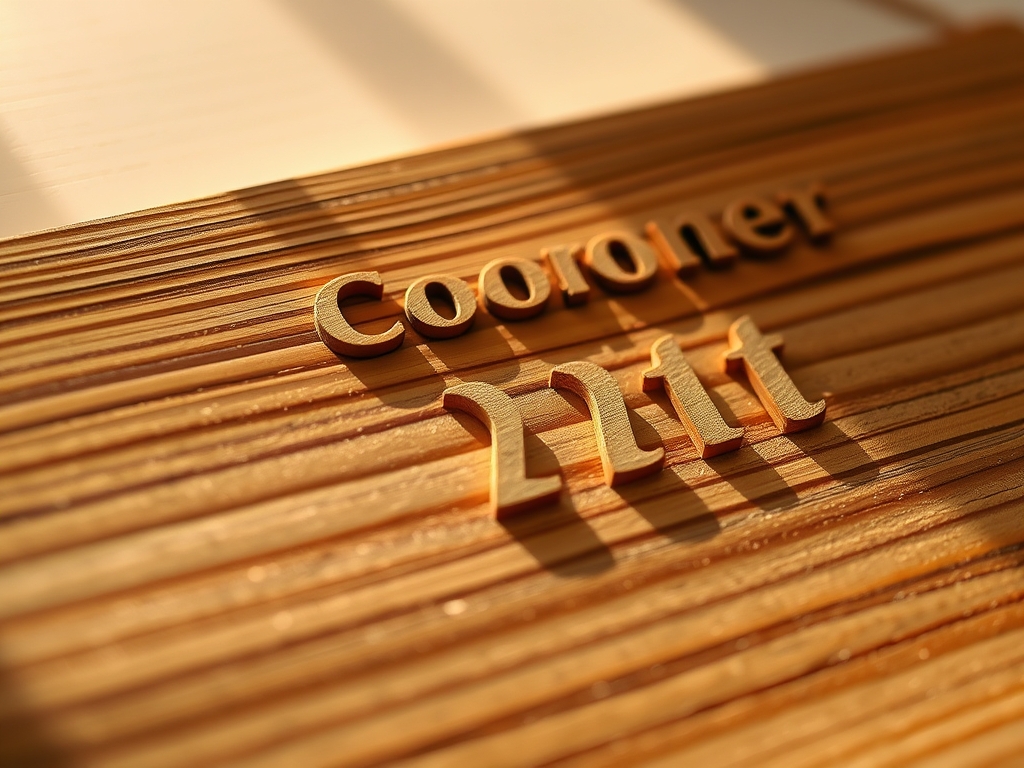
Close your eyes and listen to that specific, hollow click of kiln dried maple hitting a workbench. It is a sound that promises structural integrity and a clean slate for your creativity. When you start crafting Personalized Wooden Wall Art, you are not just hanging a decoration; you are engineering a focal point that breathes with the room. The scent of cedar oils and the fine, powdery dust of a fresh sander are your first invitations into the maker space. You can feel the grain patterns under your fingertips, tracing the lignins that hold the wood fibers together. This project is about taking raw, organic geometry and forcing it into a sophisticated, modern aesthetic. We are going to manipulate light, shadow, and texture to create something that looks like it belongs in a high end gallery but feels like home. Grab your safety goggles and a fresh pot of coffee; we are about to turn your living room into a masterclass of custom design.
THE STUDIO KIT

To execute these geometric designs with professional precision, your toolkit needs to be more than just a hammer and some nails. We are looking for dimensional stability and clean edges. You will need a high quality miter saw with a high tooth count blade to prevent tear out on your delicate angles. A digital protractor is non negotiable for ensuring your hexagons and chevrons meet with zero gap tolerance. For the assembly, use a pneumatic pin nailer; it leaves a hole so small that the wood fibers often swell back to close it naturally.
Your material list starts with the substrate. I recommend a half inch Baltic birch plywood for the backer because its cross banded layers offer superior resistance to warping. For the decorative elements, look for walnut, cherry, or white oak. These hardwoods have a high Janka hardness rating, meaning they will take a crisp edge and wont dent during the sanding process.
Material Substitutions: If your budget is tight, swap the hardwoods for MDF (Medium Density Fiberboard). It lacks the grain beauty of natural wood but offers a perfectly isotropic surface that is ideal for bold, geometric paint colors. Alternatively, use reclaimed lath for a rustic, textured look, though you must check for hidden fasteners with a metal detector first to protect your saw blades.
THE TEMPO
The "Maker's Rhythm" is a three act play. Act one is the Preparation Phase, which takes about four hours. This includes milling your lumber to a consistent thickness and mapping your geometric grid. Do not rush this; if your initial measurements are off by even a millimeter, the error will compound as you move across the board.
Act two is the Assembly Phase, lasting roughly six to eight hours depending on the complexity of your pattern. This is where you find your flow, cutting and dry fitting each piece like a high stakes puzzle. Act three is the Finishing Phase. This requires patience over two days to allow for proper off gassing of oils and the curing of wood glues. Remember that wood is hygroscopic; it will expand and contract with the humidity in your studio, so give it time to acclimate before the final seal.
THE CORE METHOD
1. The Hexagonal Honeycomb
Start by cutting thirty degree miters on small strips of oak. To ensure every piece is identical, use a stop block on your miter saw fence. This prevents "creep" and ensures the geometric integrity of the honeycomb.
Mastery Tip: Understand capillary action when gluing end grains. End grain is porous and will drink up glue, leading to a weak bond. Pre coat the ends with a thin layer of glue, let it tack up, then apply your primary bead for a permanent hold.
2. The Sunburst Chevron
This design relies on a central spine. Lay your longest pieces first, working outward in a mirrored fashion. Use a caliper to check that your strip widths are consistent to within 0.01 inches.
Mastery Tip: Use a "rub joint" technique. By sliding the glued surfaces against each other before clamping, you break the surface tension of the adhesive, creating a thinner, stronger bond line that is nearly invisible to the eye.
3. The Layered Isometric Cube
Create an optical illusion by using three different species of wood to represent highlight, midtone, and shadow. Walnut, cherry, and maple are the classic trio here.
Mastery Tip: Pay attention to grain direction. Aligning the grain to run vertically on all "face" pieces enhances the 3D effect. If the grain is chaotic, the eye will catch the inconsistency and the illusion will shatter.
4. The Concentric Square Relief
This involves nesting squares of varying thicknesses to create a topographical map effect. Use an oscillating spindle sander to smooth the interior edges of your frames.
Mastery Tip: This design tests structural integrity. Since the pieces are nested, ensure the backer board is perfectly flat. Any "cup" or "bow" in the substrate will cause the squares to sit unevenly, ruining the shadow lines.
5. The Deconstructed Herringbone
Instead of a tight fit, leave a uniform 1/8 inch gap between every slat. Use plastic spacers to maintain this spatial frequency across the entire piece.
Mastery Tip: The gaps expose the backer board, so paint the backer a matte black first. This creates a "void" effect that emphasizes the tensile strength and crispness of the wood edges.
6. The Mid Century Slat Wall
Thin, vertical slats of walnut mounted on a contrasting maple base. Use a speed square to ensure every slat is perfectly perpendicular to the base frame.
Mastery Tip: Use a burnishing tool on the edges of your slats. Compressing the wood fibers slightly before finishing results in a smoother surface that reflects light more uniformly.
7. The Geometric Inlay Name
Integrate your Personalized Wooden Wall Art by routing out a geometric shape and inlaying a different wood species. A jeweler's saw is perfect for the fine detail work required for lettering.
Mastery Tip: Wood moves. When inlaying, ensure the grain of the inlay runs in the same direction as the host piece. This prevents the pieces from fighting each other during seasonal humidity shifts.
8. The Floating Triangle Mosaic
Mount individual triangles to the wall using hidden standoffs. This creates a "floating" effect where the wall color becomes part of the art.
Mastery Tip: Use a laser level for the installation. Even a fraction of a degree of tilt will be magnified across a large wall, making the geometry look "heavy" on one side.
THE TECHNICAL LEDGER
Maintenance & Longevity: To keep your art pristine, avoid direct sunlight which can cause photo degradation of the wood lignins, turning your beautiful purples and reds into a dull grey. Dust with a microfiber cloth to avoid scratching the finish. Every two years, apply a fresh coat of high quality furniture wax to maintain the moisture barrier.
Material Variations: For a sustainable approach, use bamboo plywood, which has incredible tensile strength and a unique edge grain. For a premium look, incorporate brass or copper strips between the wood joints to add a metallic luster.
The Correction:
- Gaps in Miters: If your angles don't meet, mix fine sawdust from the project with wood glue to create a matching filler.
- Glue Squeeze Out: Never wipe wet glue with a damp cloth; it pushes the adhesive deeper into the pores. Let it dry to a "rubbery" state, then slice it off with a sharp chisel.
- Warping: If your backer board curls, screw "cleats" to the back to force it back into a flat plane.
Studio Organization: Store your wood flat, never leaning against a wall, to prevent "creep" and permanent bowing. Keep your offcuts organized by species and thickness in labeled bins to make future geometric projects faster.
THE FINAL REVEAL
There is nothing quite like the moment you peel back the painter's tape and see those crisp, geometric lines for the first time. Your living room is no longer just a room; it is a gallery of your own making. The way the light catches the different wood grains throughout the day creates a living, breathing installation. This Personalized Wooden Wall Art is a testament to your precision and your eye for design. It is sophisticated, it is tactile, and best of all, it is uniquely yours. Now, go pour yourself a glass of wine and admire the physics of your handiwork.
STUDIO QUESTIONS
How do I prevent my wood art from warping over time?
Ensure you seal both the front and back of the piece equally. This balances the moisture exchange rate, preventing the wood fibers from expanding unevenly and causing the board to cup or bow.
What is the best finish for a natural wood look?
A hard wax oil is superior for geometric art. It penetrates the fibers to provide protection while maintaining a matte, tactile feel that does not fill in the delicate grain details like thick polyurethane would.
Can I make this project without a miter saw?
Yes, you can use a hand miter box and a fine tooth pull saw. It requires more physical effort and a steady hand, but it allows for extreme precision and a very thin kerf.
How do I hang heavy wooden art safely?
Use a French Cleat system. It distributes the weight evenly across multiple wall studs and allows the piece to sit perfectly flush against the wall, ensuring the geometric shadows remain consistent.