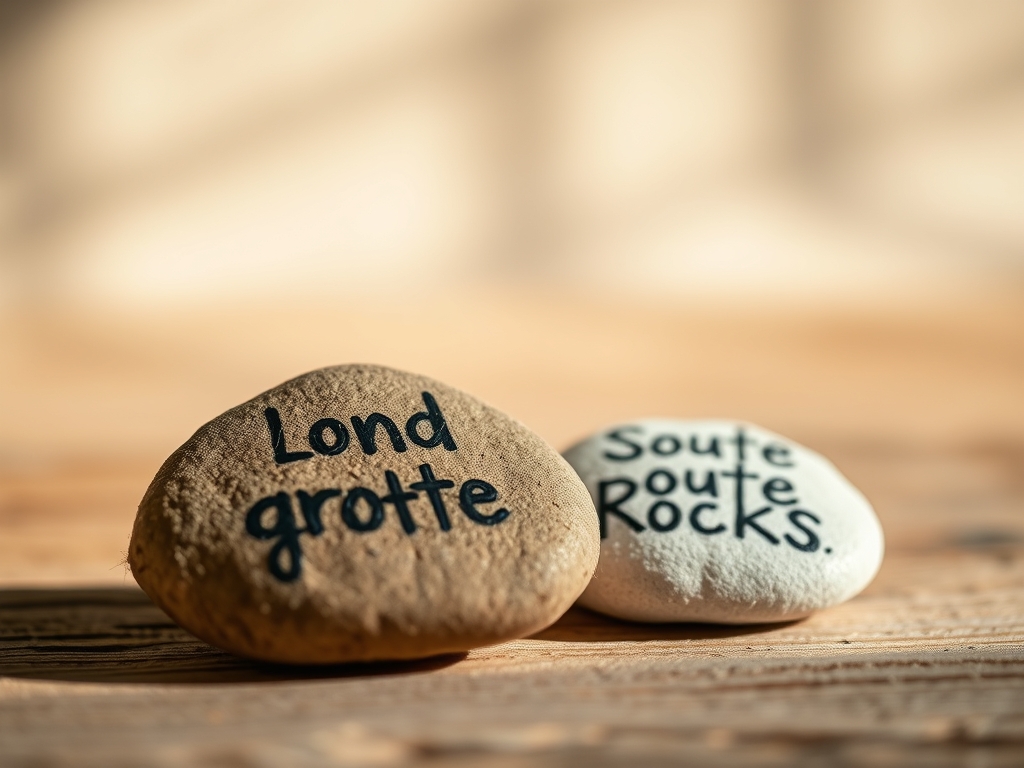
Imagine the weight of a river-smoothed basalt stone in your palm; it is cool, dense, and possesses a specific gravity that feels grounding. We are not just doodling on pebbles today. We are mastering the art of Hand Painted Quote Rocks to transform your garden path into a literal narrative. The surface of a stone is a microscopic landscape of pores and mineral veins waiting for the right viscosity of pigment to create a permanent bond.
When you run your thumb over the surface, you are feeling the result of thousands of years of hydraulic erosion. This creates a perfect canvas for high-pigment acrylics. We are looking for stones with a fine grain structure, ideally sedimentary or igneous rocks that have been tumbled by water until their surface tension is uniform. This project is about the intersection of geology and typography. We are going to use technical precision to ensure your garden whispers wisdom through every season. Grab your apron and clear your workbench; we are diving into the molecular bond between stone and ink.
THE STUDIO KIT

To achieve professional results, you need tools that respect the porous nature of the substrate. Start with a set of calipers to measure the diameter of your stones; this ensures your lettering is scaled perfectly to the available surface area. You will need acrylic paint pens with varying nib sizes, specifically 0.7mm for fine serifs and 3mm for bold strokes. These pens utilize a valve-action system to control the flow of pigment, preventing "blobbing" caused by atmospheric pressure changes in the studio.
For the base coat, use a high-opacity gesso. Gesso contains calcium carbonate which provides a "tooth" for the paint to grip, preventing the peeling that occurs with cheaper craft paints. You will also need a bone folder or a smooth wooden dowel to burnish any stencil edges, ensuring a crisp line that defies capillary action.
Material Substitutions: If you cannot find smooth river stones, you can use cast concrete discs. These have a higher alkalinity, so you must prime them with an acid-neutralizing sealer first. Instead of professional paint pens, high-pigment heavy body acrylics thinned with a flow improver (not water) will maintain the tensile strength of the paint film.
THE TEMPO
The "Maker's Rhythm" for Hand Painted Quote Rocks is dictated by evaporation rates and polymer cross-linking. You cannot rush the chemistry.
Phase 1: Preparation (30 Minutes). This includes scrubbing stones with a stiff nylon brush to remove organic biofilms and allowing them to reach thermal equilibrium with your room temperature.
Phase 2: Priming (1 Hour). Applying the base layer and allowing the moisture to leave the film.
Phase 3: The Inscription (1 to 2 Hours). This is the slow, meditative core where you manage your breath and hand stability.
Phase 4: Curing (24 Hours). This is the most critical phase. The acrylic polymers must undergo cross-linking to become water-resistant.
Phase 5: Sealing (15 Minutes + 12 Hours dry time). Applying a UV-resistant resin or polyurethane to protect the pigment from solar degradation.
THE CORE METHOD
1. Surface Debridement and Leveling
Before a single drop of paint touches the stone, you must ensure the surface is chemically clean. Use a solution of isopropyl alcohol to strip away oils from your skin. If the stone has a slight wobble, use a jeweler's saw or a small sanding block to create a tiny flat spot on the bottom for stability.
Mastery Tip: This process increases the surface energy of the rock. Higher surface energy allows the liquid paint to "wet out" more effectively, creating a mechanical bond rather than just sitting on top of the dust.
2. Mapping the Typography
Use a graphite pencil to lightly sketch your chosen word. Do not press hard; you want to avoid scoring the stone. Measure the "x-height" of your letters using your calipers to ensure mathematical symmetry across the curved plane of the rock.
Mastery Tip: Remember that stones are three-dimensional. To avoid visual distortion, you must account for the parallax effect by wrapping your letters slightly around the curve toward the horizon line of the stone.
3. The Pigment Application
Using your fine-nib pen, outline the letters first. Hold the pen at a 90-degree angle to the surface to ensure the valve-action nib dispenses an even flow. Fill in the centers using a "puddling" technique where you allow the paint to flow into the space, relying on surface tension to keep it within your outlines.
Mastery Tip: If the paint seems to feather, your stone is too porous. The science here is capillary action; the stone is literally sucking the liquid out of the paint. A second layer of gesso in the sketch area will create a non-porous barrier.
4. Precision Burnishing and Detailing
Once the ink is "tack-free," use a bone folder to gently press down any raised edges of paint. This flattens the profile of the letter, making it less susceptible to chipping when placed in the grit of a garden path.
Mastery Tip: This increases the laminar flow of rainwater over the stone. A flatter surface means water sheds faster, reducing the time the paint film is under hydraulic stress.
THE TECHNICAL LEDGER
Maintenance & Longevity: To keep your rocks vibrant, avoid placing them in direct contact with highly acidic mulch. The acid can slowly eat through the sealant. Re-apply a thin coat of UV-resistant spray every two years to combat photodegradation.
Material Variations:
- Sustainable: Use reclaimed slate from old roofing tiles; its foliated structure provides a unique, layered aesthetic.
- Premium: Choose white marble stones. The calcite crystals offer a shimmering background that makes colors pop.
The Correction:
- The Bleed: If paint runs into a crack, do not wipe it. Let it dry, then use an awl to precision-scrape the excess pigment out of the fissure.
- The Ghosting: If your pencil marks show through, use a kneaded eraser. Do not use a rubber eraser, as it leaves synthetic oils that ruin paint adhesion.
- The Crackle: If your paint cracks while drying, the layer was too thick. Sand it back with 400-grit paper and re-apply in thin microns.
Studio Organization: Store your completed rocks in a climate-controlled environment for at least 72 hours before moving them outdoors. Use a grid-style drying rack to allow airflow to the bottom of the stone, ensuring the sealant cures evenly on all sides.
THE FINAL REVEAL
Behold the transformation! What was once a silent, grey piece of the earth is now a vibrant beacon of inspiration. Your Hand Painted Quote Rocks feature crisp, professional lettering that looks etched rather than applied. When you place these along your garden path, notice how the light catches the gloss of the sealant against the matte texture of the soil. You have successfully merged the geological durability of the stone with the delicate precision of fine art. These are not just rocks; they are permanent installations of your creative spirit.
STUDIO QUESTIONS
What are the best 9 words for garden rocks?
Select high-impact, evocative words: Bloom, Wander, Roots, Breathe, Cherish, Awaken, Solace, Thrive, and Listen. These words resonate with the natural cycle of a garden while maintaining a high visual density for easy reading from a standing height.
What paint is best for outdoor rocks?
High-pigment acrylic polymers are superior due to their flexibility. They expand and contract with the stone during thermal shifts. Ensure the paint is labeled "lightfast" to prevent the UV rays from breaking down the chemical pigment bonds over time.
How do you seal rocks for the garden?
Use a non-yellowing polyurethane or an outdoor-rated resin. Apply in thin, multiple coats rather than one thick layer. This ensures the sealant penetrates the micro-pores of the stone, creating a moisture-proof barrier that prevents frost wedging and peeling.
Why is my paint peeling off the rock?
Peeling usually indicates a failure in mechanical adhesion. This happens if the stone was damp, oily, or too smooth. Always de-grease with alcohol and use a gesso primer to create a "tooth" for the acrylic molecules to grip effectively.